Unlocking Subatomic Power: Your Beginner Guide to Quantum Computing
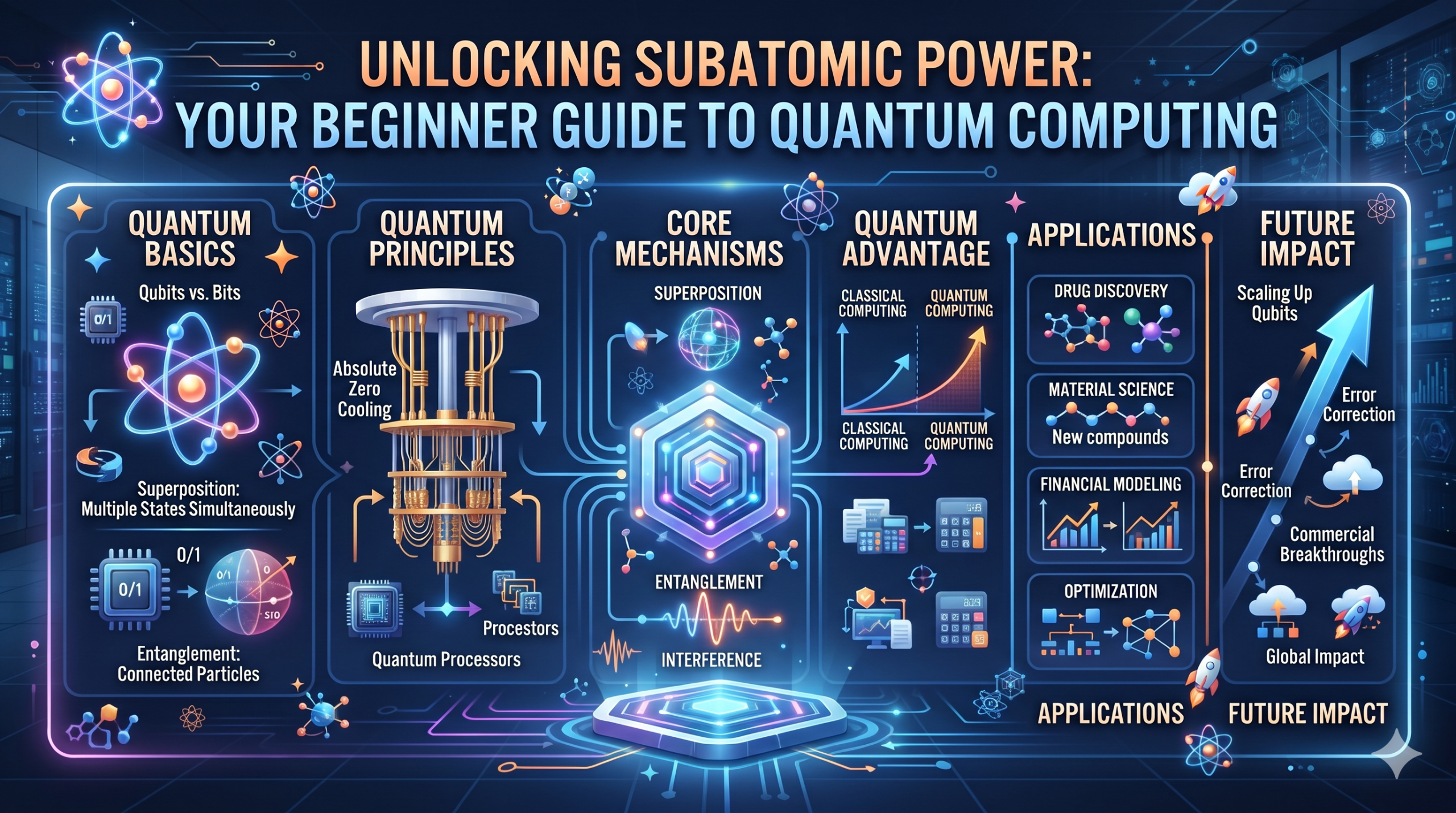
Launching Into the Next Era of Computing
Modern science stands on the edge of a massive computing shift. Today, engineers, software developers, and security analysts pour energy into building machines that abandon standard silicon chips. Instead of flipping microscopic electrical switches, these new processors harness the natural laws of subatomic physics to solve previously impossible puzzles.
Regular computers crunch numbers step by step using predictable electrical currents. Quantum machines manipulate electrons, ions, and light particles to navigate vast mathematical spaces in fresh ways.
Across this guide, you will learn how quantum technology operates from the ground up. We break down qubits, logic gates, circuit designs, famous algorithms, and future encryption methods using plain language and everyday examples. QuantumUting helps students, programmers, and curious minds decode the quantum future through practical tutorials and clear educational guides.
Comparing Quantum Machines with Everyday Computers
Examining quantum computing vs classical computing shows why both technologies play vital roles. Your laptop and smartphone rely on classical computing, which handles daily tasks like streaming video, editing documents, and browsing the web with unmatched speed and reliability. Quantum computers act as specialized scientific accelerators built for narrow, mathematically intense problems.
Key Feature
Classical Systems
Quantum Systems
Core Data Unit
Standard bit (0 or 1)
Qubit (0, 1, or superposition blend)
Governing Rules
Classical Boolean logic
Laws of quantum mechanics
Control Operations
Electronic gates (AND, OR, NOT)
Quantum gates (Hadamard, Pauli, CNOT)
Operating Environment
Runs at normal room temperature
Requires extreme cryogenic cooling
Ideal Applications
Everyday apps, databases, gaming
Molecular simulation, factoring, optimization
Quantum processors will never replace your personal computer. Classical chips remain far cheaper and faster for routine software workloads. Future data centers will pair both machines together, routing everyday tasks to silicon processors and complex simulations to quantum hardware.
Defining the Basics of Quantum Mechanics
People searching for quantum computing for beginners often picture a supercharged desktop computer. In reality, quantum computing introduces an entirely separate way to process information rooted in quantum mechanics. Quantum mechanics describes how nature behaves at the smallest atomic scales, where normal physical intuition stops working.
Imagine a regular office computer as a giant table covered in flat coins. Every coin displays either heads or tails. Now picture a quantum processor as a table full of rapidly spinning coins that blur both outcomes together until someone stops them.
Scientists design these systems to simulate chemical reactions, discover targeted medicines, and model complex financial risks. Engineers still work daily to shield sensitive quantum chips from heat and vibration. Mastering these foundational concepts gives you an early edge as the technology matures.
Understanding Qubits, Superposition, and Entanglement
Asking what is a qubit takes you directly to the basic building block of quantum information science. A qubit, short for quantum bit, stores and processes quantum data. While a classical bit holds a strict 0 or 1, a qubit unlocks two extraordinary physical capabilities:
Superposition: A qubit maintains a fluid combination of 0 and 1 simultaneously. Like a coin spinning upright on a desk, it carries the potential for both results until a detector stops its motion.
Entanglement: Multiple qubits form deep, invisible connections across space. When you alter one entangled qubit, its partner reacts instantaneously regardless of the distance separating them.
Measuring a qubit collapses its superposition immediately. The spinning coin lands flat, and the system records a clear 0 or 1. Linking dozens of entangled qubits lets programmers evaluate intricate data patterns simultaneously.
Real-World Applications Shaping Future Industries
Scientists and business leaders actively test real-world applications of quantum computing across high-impact sectors. While most projects remain in research and pilot phases, five industries show tremendous promise:
Pharmaceutical Discovery: Medical researchers simulate molecular interactions to design targeted drugs faster than traditional lab trials allow.
Clean Energy Materials: Chemists model new atomic structures to build lighter aircraft alloys and higher-capacity electric vehicle batteries.
Supply Chain Optimization: Logistics planners evaluate millions of delivery routes simultaneously to cut fuel costs and reduce shipping delays.
Financial Risk Analysis: Quantitative analysts simulate complex market conditions to price assets accurately and detect subtle fraud patterns.
Artificial Intelligence: Machine learning teams test quantum circuits to accelerate data classification and optimize complex models.
As engineers lower hardware error rates and increase qubit counts, these experimental pilots will evolve into practical business tools.
Steering Qubits with Quantum Logic Gates
Classical computers run programs by sending electrical currents through logic gates. Quantum processors transform qubit states using specialized operations called quantum gates. Reviewing quantum gates explained with simple examples reveals how developers control subatomic data:
Hadamard Gate (H): This gate pushes a resting qubit into superposition, creating an equal probability of measuring 0 or 1.
Pauli-X Gate: This operation flips a qubit's value, changing a 0 into a 1 or a 1 into a 0.
Pauli-Z Gate: This tool reverses the internal rotational phase of a spinning qubit without changing its 0 or 1 probability.
CNOT Gate (Controlled-NOT): This two-qubit gate flips a target qubit only when a control qubit equals 1, binding both particles into entanglement.
Every quantum gate operates reversibly. Programmers can always run a gate sequence backward to restore qubits to their original starting states.
Assembling Gates: A Beginner Quantum Circuits Tutorial
A quantum circuit arranges individual qubits and logic gates into a structured workflow. You read a circuit diagram from left to right, much like musical notes flowing across horizontal lines.
Follow this quick quantum circuits tutorial to trace a basic two-qubit program:
Set Starting Values: Two qubits enter the left side of the diagram, both initialized to 0.
Enter Superposition: The first qubit passes through a Hadamard gate, creating a balanced mix of 0 and 1.
Create Entanglement: A CNOT gate connects the first qubit to the second, linking their states together.
Measure the Result: Measurement symbols on the far right collapse the qubits and output standard 0s and 1s.
You do not need a physics laboratory to test circuits today. Developers use Qiskit, an open-source Python toolkit, to write code and simulate quantum circuits right on standard laptops.
Solving Complex Problems with Quantum Algorithms
While a circuit maps out physical gate sequences, an algorithm provides the mathematical strategy to solve a specific problem. Studying quantum computing algorithms explained clearly shows why programmers write quantum software differently than traditional code.
Because measuring a qubit destroys its superposition, quantum algorithms use wave interference. Programmers design gate sequences that boost the probability of correct answers while canceling out wrong outcomes.
Two famous algorithms demonstrate this clever strategy:
Grover’s Algorithm: This search method finds target items inside massive, unsorted databases much faster than classical search routines.
Shor’s Algorithm: This factoring method breaks giant numbers down into their original prime multipliers.
Quantum algorithms accelerate only problems that contain specific mathematical structures. Routine tasks like sorting spreadsheets gain zero advantage from quantum interference.
Shor's Algorithm Explained: Prime Factoring and Digital Locks
Mathematician Peter Shor invented an algorithm that reshaped how security experts view modern encryption. His routine solves a classic math puzzle called integer factorization.
Factoring asks you to find which prime numbers multiply together to create a larger target number. You can easily factor 35 into 5 times 7 in your head. However, finding the prime factors of a 600-digit integer forces today's fastest supercomputers to calculate for millions of years.
Reading Shor's algorithm explained simply highlights why cybersecurity teams track quantum hardware progress closely. Popular internet encryption protocols protect banking sites and private chats by hiding behind massive prime factors. A large, error-free quantum computer running Shor's routine could crack those factors quickly. Current quantum machines lack the scale to threaten online encryption today, giving engineers time to upgrade global defenses.
Protecting Online Privacy with Post-Quantum Cryptography
Every online payment and encrypted message relies on public-key cryptography to block hackers. Traditional encryption locks digital information behind math problems that classical computers cannot solve within a practical timeframe.
Exploring post-quantum cryptography explained in plain English shows how security researchers protect future networks. Cryptographers actively create fresh encryption standards built on complex mathematical lattices and multidimensional grids. Neither classical supercomputers nor future quantum processors can easily untangle these new puzzles.
Keep in mind that post-quantum cryptography differs completely from quantum cryptography. Post-quantum security runs as standard software on existing phones, laptops, and cloud servers. Quantum cryptography uses specialized optical hardware that sends single photons through fiber-optic cables to detect eavesdroppers. Major technology organizations already deploy post-quantum software updates to safeguard sensitive records ahead of future hardware breakthroughs.
Seven Quantum Computing Myths Beginners Must Avoid
Exaggerated headlines often create confusion about what quantum computers actually do. Steer clear of these frequent misunderstandings as you build your knowledge:
Believing quantum machines speed up every task: Quantum processors accelerate specific math and simulation problems, not daily office software.
Thinking a qubit stores two classical bits: A qubit holds continuous probability amplitudes rather than two separate binary digits side by side.
Confusing superposition with brute-force parallel processing: Quantum computers use wave interference to highlight patterns instead of checking every answer at once.
Assuming entanglement sends faster-than-light messages: Measuring entangled qubits shows instant correlations, but physical laws prevent transmitting messages faster than light.
Expecting classical computers to disappear: Future data centers will pair classical CPUs and GPUs alongside specialized quantum accelerators.
Waiting to master theoretical physics before coding: Programmers with basic Python skills can write and simulate circuits immediately.
Mistaking early lab prototypes for finished commercial products: Large-scale, fault-tolerant quantum computers remain an active engineering goal.
How to Learn Quantum Computing: Your Ten-Step Path
Anyone wondering how to learn quantum computing can succeed by taking steady, manageable steps. You do not need a physics degree to start writing quantum programs. Work through these ten practical milestones at your own pace:
Review Core Math: Refresh high school algebra, basic probability, and complex numbers.
Study Linear Algebra Basics: Practice working with vectors and matrices, which represent qubit states and gate operations.
Learn Core Quantum Concepts: Read beginner guides explaining superposition, measurement, and entanglement.
Master Qubit Notation: Practice writing single-qubit and multi-qubit states using standard bracket notation.
Memorize Key Logic Gates: Learn how Hadamard, Pauli-X, Pauli-Z, and CNOT gates transform qubit values.
Trace Circuit Diagrams: Draw small circuits on paper and calculate their final measurement probabilities.
Practice Basic Python: Build comfort with Python syntax, functions, and lists.
Run Qiskit Simulators: Install Qiskit on your computer and execute your first simulated quantum circuit.
Code Starter Algorithms: Build introductory routines like Deutsch-Jozsa or basic Grover search examples.
Join Developer Communities: Share your coding exercises, ask questions, and learn alongside fellow enthusiasts.
Consistent weekly practice turns unfamiliar math symbols into intuitive programming skills.
Growing Your Technical Skills with QuantumUting
Mastering a complex technical subject becomes much easier when you follow structured, jargon-free guides. QuantumUting operates as an educational platform dedicated to decoding the quantum future for curious learners worldwide. Students, software developers, researchers, and security professionals explore our articles to build solid foundational knowledge.
Our educational tutorials walk you through qubits, logic gates, circuit design, and quantum algorithms step by step. You can also explore linear algebra essentials, Qiskit coding examples, and post-quantum security trends at your own speed. Pairing regular reading with hands-on simulator practice empowers you to build lasting technical fluency.
Answering Common Questions About Quantum Technology
In simple words, how does quantum computing work? Quantum computing processes data using subatomic physics rather than standard electrical switches. This approach allows specialized machines to solve complex mathematical and scientific puzzles that overwhelm classical computers.
How does a qubit differ from a classical binary bit? A classical bit holds a single fixed value of either 0 or 1. A qubit leverages superposition to exist in a fluid blend of both 0 and 1 until a measurement forces it to choose one outcome.
Will quantum processors eventually replace standard laptops? No, classical laptops and smartphones handle daily tasks like web browsing, video calls, and gaming much faster and cheaper. Quantum computers act as specialized co-processors for scientific modeling, optimization, and advanced math.
Must beginners hold a physics degree to study quantum programming? You only need basic high school math, introductory linear algebra, and beginner Python skills. Developers can write and test quantum circuits on laptop simulators without mastering advanced theoretical physics first.
How do logic gates control qubits inside a circuit? Quantum gates apply precise operations that change the state or rotational phase of qubits. Programmers arrange these reversible gates in sequences to guide qubits toward a desired mathematical answer.
What happens step by step inside a quantum circuit? A quantum circuit feeds initialized qubits through a specific sequence of quantum gates from left to right. At the end of the path, measurement tools convert the final quantum states into readable 0s and 1s.
Why does Shor's algorithm matter so much to cybersecurity teams? Shor's algorithm factors enormous numbers exponentially faster than classical routines. Because current internet encryption relies on the difficulty of factoring large numbers, this algorithm drives global efforts to adopt quantum-resistant security.
Can today's quantum computers break encrypted banking data? Current quantum hardware lacks the qubit count and error correction needed to break modern encryption. Security teams already deploy post-quantum cryptographic software to protect sensitive networks long before powerful quantum machines arrive.
Which industries stand to benefit most from quantum breakthroughs? Pharmaceuticals, clean energy, global logistics, finance, and artificial intelligence show the strongest potential. Researchers use quantum prototypes to model new drugs, improve battery chemistry, and optimize complex supply networks.
How can a complete beginner start learning quantum computing today? Begin by reviewing basic probability, vectors, matrices, and Python programming. Next, download a free framework like Qiskit and follow beginner tutorials to run simple circuits on your own computer.
Taking Your Next Step into the Quantum Future
Building knowledge in quantum computing opens exciting doors across modern science, software engineering, and cybersecurity. By understanding how qubits, logic gates, circuits, and algorithms connect, you gain clear insight into how next-generation computers solve hard problems. Hardware engineers advance physical capabilities every day, making now the ideal moment to build your foundational skills.
Keep experimenting with code simulators, stay curious, and tackle one new concept each week. Visit QuantumUting whenever you want clear explanations, coding tutorials, and practical guides across quantum information science. Start exploring today and take your next active step toward decoding the quantum future.