SRESchool.com Practitioner Guide for Cloud Reliability Engineering
Introduction
Securing immaculate application uptime demands rigorous operational discipline and forward-looking architectural design across modern engineering groups. Frequent digital disruptions shatter customer trust instantly while draining developer energy through chaotic emergency troubleshooting. Site Reliability Engineering introduces systematic software methodologies that eradicate operational bottlenecks and stabilize brittle cloud environments. Dedicated platforms like SRESchool.com supply comprehensive educational pathways that empower engineers to conquer these technical hurdles. Whether you want to optimize incident workflows, automate manual chores, or enhance observability pipelines, targeted instruction accelerates professional growth. Embracing these core tenets fundamentally transforms how technical organizations design, build, and sustain dependable systems.
Understanding SRE as a Service
SRE as a Service grants organizations continuous access to external reliability expertise for cloud infrastructure management. Smaller enterprises leverage this outsourced support model instead of building large internal reliability teams from scratch. The service typically covers monitoring setup, incident triage, automation creation, and ongoing reliability assessments. While not every business requires outsourced assistance, this model offers flexibility during periods of rapid scaling. SRE as a Service preserves high service availability while internal teams focus on core product features. It functions as a seamless extension of your engineering department when specialized reliability bandwidth runs short.
Why Corporate SRE Training Can Help Engineering Teams
Scaling reliability practices across an entire enterprise requires a shared technical vocabulary and unified operational understanding. Corporate SRE Training aligns software developers, DevOps personnel, and infrastructure teams around common reliability objectives. Companies tailor these training programs to match their specific cloud providers, architectures, and internal working environments. Collaborative training fosters a culture where reliability represents a shared team responsibility rather than an isolated silo. This collective alignment minimizes friction between development and operations departments, enabling faster and safer deployments. Investing in corporate training builds sustainable technical resilience from the ground up.
Learning Through Practical SRE Tutorials
Engaging with targeted SRE Tutorials offers learners an accessible method to master complex engineering concepts incrementally. Tutorials guide participants through actionable tasks like configuring basic monitoring dashboards or calculating accurate error budgets. These practical guides bridge the gap between abstract theoretical principles and tangible production implementations. Learners experiment safely with configuration files, log aggregators, and testing tools inside isolated sandbox environments. Exploring diverse tutorials builds technical confidence before pushing configuration changes to live production systems. Consistent practice via guided tutorials reinforces problem-solving abilities essential for modern infrastructure engineers.
Exploring SRE Tools for Modern Reliability Engineering
Selecting appropriate technologies remains vital for maintaining complete visibility across distributed cloud production environments. SRE Tools span multiple distinct categories, each fulfilling a specialized operational lifecycle role.
- Monitoring and Metrics: Software gathering numerical time-series data to track CPU, memory, and request rates.
- Logging: Systems ingesting, indexing, and querying application and infrastructure log streams.
- Distributed Tracing: Technologies tracking request pathways across microservices architectures to isolate latency bottlenecks.
- Incident Management: Platforms handling on-call paging, alert routing, and team collaboration during outages.
- Infrastructure Automation: Code-driven software provisioning and configuring cloud resources consistently.
Tool selection depends entirely on scale, architecture, budget, and team familiarity rather than universal superiority.
Understanding SLOs, SLIs, and Error Budgets
Service Level Indicators measure explicit performance aspects like request latency and system error rates. Service Level Objectives define target reliability percentages for those indicators over specific evaluation windows. Error budgets establish acceptable unreliability thresholds before development teams must pause new feature releases. This framework transforms subjective quality debates into objective, data-driven conversations between product and engineering groups. Healthy error budgets allow rapid feature shipping, whereas depleted budgets shift focus toward reliability work. This balanced methodology aligns engineering velocity with customer expectations seamlessly.
How Observability Supports Site Reliability Engineering
Observability enables engineering teams to deduce internal system states based entirely on external outputs. Unlike traditional monitoring that merely flags failures, observability explains the root causes behind system anomalies. Combining metrics, logs, and distributed traces into centralized dashboards grants deep visibility into microservices. When incidents strike, engineers query telemetry data to trace faults across dependent service boundaries. Strong observability practices drastically reduce mean time to resolution during critical production emergencies. Cultivating these analytical habits forms the cornerstone of effective production engineering.
Understanding Incident Management and Postmortems
Production incidents remain inevitable within complex software ecosystems, making structured incident management an indispensable capability. Effective incident workflows involve rapid detection, clear paging, cross-functional triage, and transparent communication. Resolving the crisis leads directly into blameless postmortems where teams analyze root causes objectively. Postmortems focus on systemic flaws and process improvements rather than assigning blame to individual engineers. Documenting findings and generating actionable follow-up tickets prevents identical failures from recurring. This continuous feedback loop strengthens overall system resilience over time.
How Automation and Toil Reduction Improve Reliability
Manual operational tasks hamper deployment speed and elevate human error risks during routine updates. Automation allows SRE teams to replace repetitive chores with reliable scripts, pipelines, and self-healing mechanisms. Reducing toil frees up valuable engineering hours for high-impact architecture and feature development projects. Poorly designed automation introduces fresh risks if scripts fail silently without proper monitoring oversight. Therefore, automation code requires rigorous testing, peer review, and maintenance matching application software standards. Balancing automation with diligent oversight establishes a stable operational environment.
Understanding Capacity Planning and Cloud Reliability
Anticipating future resource demands ensures applications maintain peak performance during unexpected traffic surges. Capacity planning involves analyzing historical usage patterns, performance metrics, and business forecasts to project infrastructure needs. Cloud reliability practices ensure resources scale dynamically without exceeding budgets or degrading service performance. SRE teams monitor resource limits, network bandwidth, and database scaling thresholds continuously. Proactive capacity management stops sudden outages triggered by resource exhaustion during peak traffic windows. Aligning technical capacity with business growth secures dependable cloud delivery.
Building a Practical SRE Implementation Approach
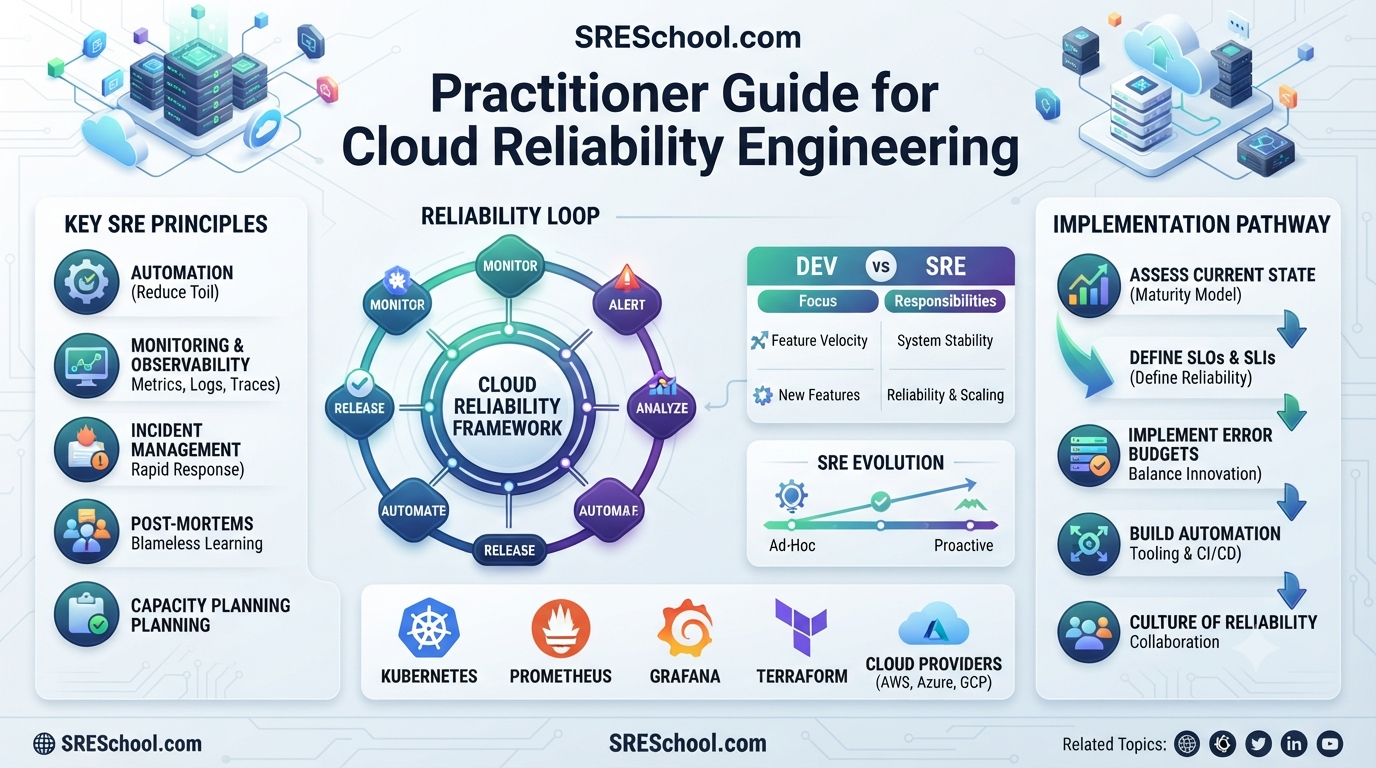
Adopting reliability engineering practices demands a gradual, deliberate strategy customized to organizational maturity levels. Attempting to deploy every advanced SRE concept simultaneously invites employee burnout and systemic resistance.
- Assess Current State: Evaluate existing monitoring gaps, incident workflows, and team workloads.
- Define Initial Metrics: Establish baseline SLIs and SLOs for critical user-facing services.
- Improve Observability: Guarantee reliable team access to logs, metrics, and traces during incidents.
- Automate Repetitive Tasks: Identify high-toil chores and build simple automation scripts.
- Iterate and Refine: Review postmortems regularly and adjust reliability targets based on feedback.
Phased adoption ensures sustainable cultural and technical progress.
How SRESchool.com Supports SRE Learning and Professional Development
Mastering reliability engineering requires reliable access to structured educational materials and expert guidance. SRESchool.com supplies a dedicated learning environment where engineers explore SRE Training, certification pathways, and curated tutorials. Whether you study fundamental SLO concepts or evaluate modern SRE Tools, the platform fosters continuous growth. Comprehensive resources bridge knowledge gaps for DevOps engineers, platform architects, and operations specialists alike. Centralized learning materials make mastering robust reliability skills straightforward for technical practitioners. Leveraging these resources empowers engineers to build highly resilient production systems.
Why Reliable SRE Knowledge Is Becoming More Important
As digital infrastructure grows increasingly complex, system failures carry mounting operational and financial consequences. Organizations can no longer depend on guesswork when managing modern cloud-native production platforms. Reliable SRE knowledge supplies proven frameworks for maintaining uptime, controlling risk, and scaling engineering output. Professionals commanding observability, automation, and error budgeting skills enjoy immense industry demand. Prioritizing continuous learning in reliability safeguards organizational reputation and customer trust alike. Cultivating this expertise constitutes a strategic investment for every technology-driven enterprise.
Understanding Site Reliability Engineering and Why It Matters
Site Reliability Engineering emerged to bridge the traditional divide between software development teams and IT operations groups. Traditional server management models often relied heavily on manual intervention, causing severe engineer burnout and fragile production environments. SRE leverages software automation to run scalable, highly available systems without requiring endless manual oversight. Instead of reacting blindly to constant alerts, modern teams measure system health and implement proactive automated safeguards. This approach matters because users expect digital services to perform reliably around the clock without interruptions. Prioritizing system stability from day one protects organizational revenue, brand reputation, and long-term customer trust.
What Professionals Can Learn Through SRE Training
Participating in structured SRE Training empowers engineers to master complex production systems with technical precision. Learners investigate core concepts including service level objectives, error budgets, telemetry aggregation, and incident response workflows. Training curriculums explicitly target toil reduction, helping teams eliminate repetitive manual chores that lack engineering value. Practitioners also discover how to anticipate traffic spikes, engineer fault-tolerant architectures, and troubleshoot intricate cloud environments effectively. These essential capabilities shift engineering culture away from reactive firefighting toward proactive system design. Software developers, DevOps specialists, and system administrators all gain tremendous value from acquiring these competencies.
Understanding SRE Certification and Professional Skill Development
Pursuing an SRE Certification grants technical professionals a transparent framework to validate their reliability expertise. Certification standards, testing formats, and eligibility prerequisites vary depending on the specific credentialing organization involved. Preparing for these exams pushes engineers to explore advanced topics like postmortem analysis, SLO creation, and observability telemetry. Holding a credential does not automatically guarantee instant job promotions or massive salary hikes in today's market. Instead, certification functions as a meaningful personal milestone that highlights verified foundational knowledge and professional growth. Combining certified study with hands-on production experience yields the greatest career advancement.
Choosing a Site Reliability Engineering Course
Selecting an effective Site Reliability Engineering Course requires evaluating curriculum depth, practical labs, and real-world relevance carefully. A well-designed course balances theoretical concepts with hands-on labs covering alert configurations and automation scripts. Learners examine how reliability metrics function across microservices and distributed cloud environments. Reviewing course outlines helps ensure the material aligns directly with your current technical skill set and career aspirations. Structured learning paths accelerate your comprehension whether you are transitioning from traditional IT or sharpening your software engineering expertise. Choosing the right course helps you apply proven reliability patterns directly to your daily production work.
What It Means to Become a Certified Site Reliability Engineer
Becoming a Certified Site Reliability Engineer marks a significant milestone in mastering production engineering and operational stability. Certified professionals demonstrate deep comprehension regarding uptime measurement, incident response orchestration, and workflow automation. They balance feature delivery velocity with system resilience by utilizing data-driven error budgets effectively. This role demands strong cross-functional collaboration as engineers partner with developers to enhance code maintainability and observability. Holding a certification reflects a commitment to rigorous engineering standards rather than mere patch-oriented troubleshooting. It signals to peers and leadership that you prioritize proactive reliability above all else.
Focus Area
Core Competency
Practical Application
Observability
Metrics, logs, and traces
Uncovering live system behavior
Reliability
SLOs and error budgets
Balancing shipping speed with stability
Operations
Incident management
Resolving production outages efficiently
Automation
Toil reduction
Eliminating manual, repetitive tasks
Exploring SRE Consulting for Organizations
Growing enterprises frequently reach stages where internal engineering teams require external expertise to scale infrastructure reliability. SRE Consulting helps businesses audit their reliability maturity, pinpoint operational bottlenecks, and architect robust systems. Expert consultants evaluate existing monitoring frameworks, incident workflows, and deployment pipelines to recommend strategic improvements. This external viewpoint helps leadership uncover hidden technical debt before it triggers catastrophic production failures. Partnering with seasoned practitioners allows companies to adopt industry best practices rapidly while avoiding expensive trial-and-error cycles. Tailored consulting ensures reliability strategies align precisely with company goals and technology stacks.
Frequently Asked Questions About SRESchool.com
What specific operational value does SRESchool.com provide for modern technology enterprises?
SRESchool.com operates as a specialized global learning and professional services platform dedicated to advancing Site Reliability Engineering practices.
What core technical proficiencies do learners acquire through structured training modules?
Participants build hands-on expertise spanning service level objectives, error budgets, observability platforms, incident management, and cloud reliability.
Does the web platform host accredited professional credential programs?
The site supports professional growth by directing engineers through structured educational paths tailored for reliability careers.
Who stands to gain the greatest advantage from undertaking an SRE course?
DevOps specialists, cloud engineers, platform architects, software developers, and operations staff all secure vital production insights.
What professional competencies characterize a certified reliability practitioner?
Certified engineers demonstrate mastery in uptime measurement, telemetry monitoring, incident routing, and production engineering standards.
How do corporate entities utilize external consulting services?
Companies engage seasoned consultants to evaluate reliability maturity, design SLO frameworks, optimize observability, and decrease operational toil.
What major benefits does SRE as a Service deliver to expanding businesses?
This model supplies continuous external reliability expertise and operational backing for cloud infrastructure platforms.
How does corporate training assist internal technical departments?
Corporate programs unite engineering groups around standardized reliability frameworks aligned with their specific technology stacks.
What categories of technology do practical tutorials examine?
Tutorials investigate software dedicated to monitoring, logging, tracing, incident management, and infrastructure automation.
Is prior engineering background mandatory before accessing these learning resources?
While basic administration knowledge assists learning, modules accommodate technical professionals across diverse career stages.
Final Thoughts
Advancing cloud resiliency demands a dedicated commitment to proactive engineering habits over reactive crisis management. Cultivating these operational competencies safeguards business revenue and guarantees seamless customer experiences at scale. Utilize specialized platforms like SRESchool.com to master advanced reliability frameworks and elevate your technical capabilities. Treat system dependability as a continuous journey that drives long-term organizational success.