Quantum Computing Training, Cloud Systems, and Career Certification Guide
Introduction
Complex computational hurdles increasingly push classical supercomputers beyond their practical limits. Quantum computing solves these problems by harnessing quantum mechanics to process data through subatomic states instead of standard binary switches.
Conventional computers evaluate instructions sequentially or across predictable parallel threads, whereas quantum processors use quantum bits—or qubits—to explore vast calculation spaces simultaneously. This architectural transformation lets scientists simulate molecular structures, optimize intricate supply chains, and strengthen cryptographic security.
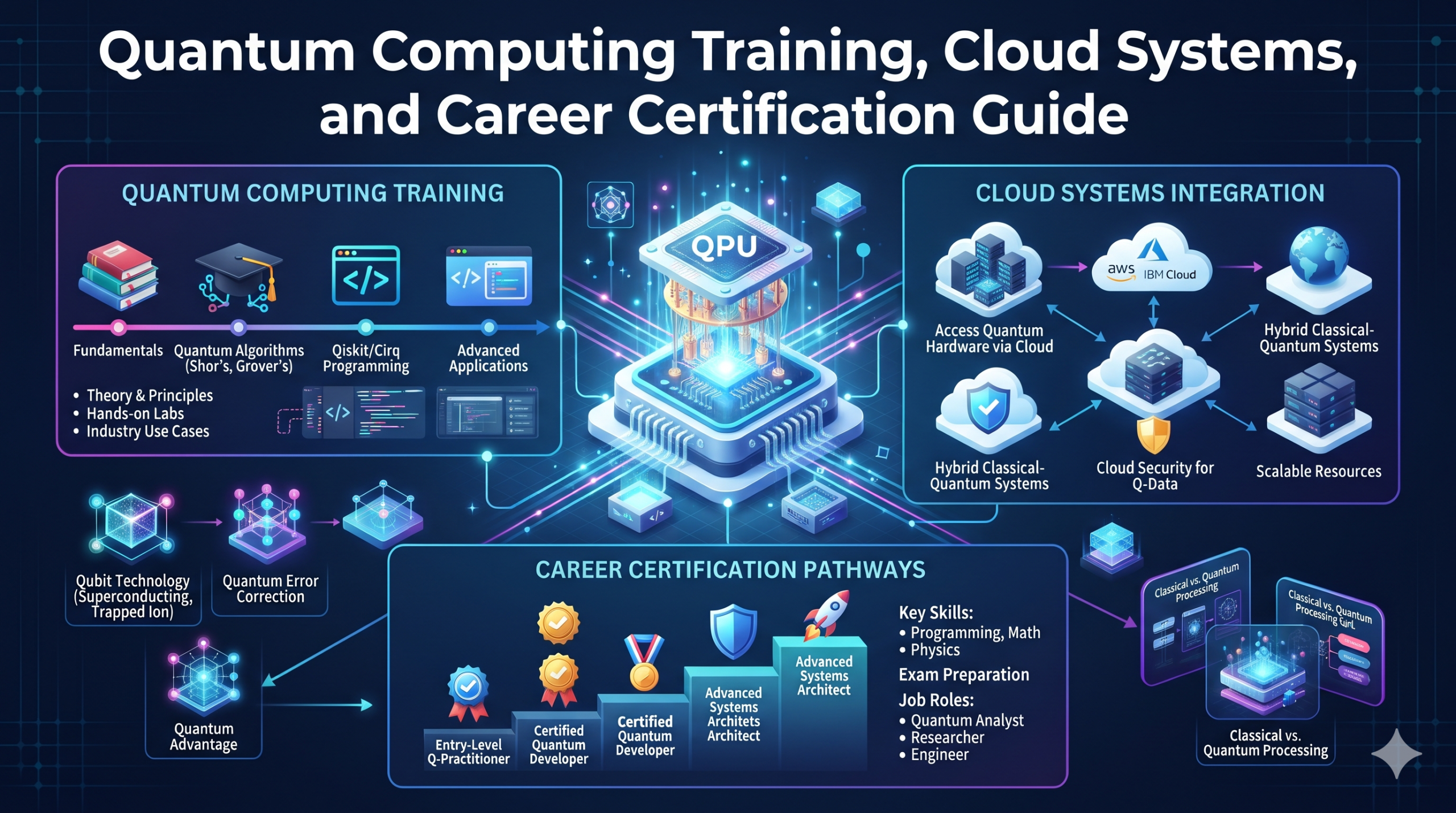
Leading cloud providers now stream remote access to physical quantum machines over standard internet connections, inspiring software developers, cloud engineers, system architects, researchers, and IT managers to build practical skills. Mastering how quantum workloads connect with existing cloud ecosystems gives technology professionals a forward-looking edge. QuantumOps School guides practitioners through this transition with specialized quantum computing education, role-based certification tracks, and enterprise consulting services.
Core Principles of Quantum Computing Made Simple
Engineers do not need an advanced theoretical physics degree to understand how quantum computers operate. A small set of foundational principles governs how quantum systems encode, transform, and extract data.
Quantum Concept
Plain-Language Explanation
Classical bits
Traditional computers store information as binary digits acting like switches set strictly to 0 or 1.
Qubits
Quantum bits serve as the fundamental units of quantum information, holding 0, 1, or a fluid combination of both states simultaneously.
Superposition
This property lets a qubit occupy multiple states at once until measurement occurs, much like a spinning coin before it lands flat.
Entanglement
Entanglement links two or more qubits together so altering one immediately updates its partner across any physical distance.
Quantum gates
Developers apply quantum gates to manipulate qubit states, shift outcome probabilities, and connect qubits through entanglement.
Quantum circuits
Engineers organize sequences of quantum gates into structured circuits to execute step-by-step computational routines.
Quantum measurement
Measuring a qubit collapses its superposition into a concrete classical bit of either 0 or 1.
Quantum algorithms
Mathematicians design specialized algorithms that use wave interference to amplify accurate answers while canceling out incorrect paths.
Quantum machines do not beat traditional laptops or servers across every workload. Classical processors execute web browsing, spreadsheet modeling, and database queries far faster and more reliably. Quantum hardware delivers potential speedups only for targeted mathematical problems suited to specialized quantum algorithms.
Quantum Computing vs Classical Computing: Key Structural Differences
Examining traditional and quantum architectures side by side shows why enterprises combine both systems rather than replacing existing servers.
Basic information unit: Classical computers rely on binary bits (0 or 1), while quantum computers use qubits capable of superposition.
Processing logic: Classical machines execute deterministic logic gates, whereas quantum processors apply probabilistic gates and wave interference.
Physical hardware: Traditional servers run room-temperature silicon transistors, while quantum chips require superconducting loops, trapped ions, or photonics.
Coding style: Standard software uses imperative or object-oriented languages, whereas quantum developers construct gate-level circuits.
Error control: Classical hardware uses mature redundancy checks, while fragile qubits require active error mitigation to counter environmental noise.
Primary workloads: Classical servers power web apps, databases, and enterprise ERP, while quantum hardware targets molecular chemistry, cryptography, and complex optimization.
Facility needs: Standard data centers house classical servers, whereas quantum systems demand cryogenic dilution refrigerators, vacuums, and cloud APIs.
Classical servers will always anchor global digital infrastructure. Because quantum processors do not store large databases or render graphical interfaces, they operate as specialized accelerators. Classical computers prepare raw datasets, dispatch targeted calculations to a quantum chip, and interpret the returned measurements.
Cloud Quantum Computing: Running Workloads Without Physical Hardware
Operating physical quantum hardware demands extreme cryogenic cooling, vacuum isolation, and dedicated physics specialists. Quantum cloud computing removes these barriers by letting engineers write code locally and execute jobs on remote quantum processors via the internet.
Taking quantum cloud computing training teaches practitioners how cloud providers orchestrate quantum workflows from start to finish. Ecosystems such as IBM Quantum, AWS Braket, and Azure Quantum offer unified portals where developers test diverse hardware architectures without purchasing physical machines.
API-driven hardware access: Developers connect to remote quantum processing units (QPUs) through standard SDKs and cloud endpoints.
Classical simulators: Engineers verify and debug quantum circuits on classical cloud servers before spending budget on physical QPU runs.
Shared queue scheduling: Cloud platforms coordinate global user queues to share access across scarce physical quantum processors.
Batch job execution: Users package circuits into discrete tasks, submit them to cloud queues, and run thousands of repetitions ("shots") to generate probability distributions.
Cloud ecosystem integration: Architects link quantum tasks with standard object storage, compute instances, and monitoring dashboards.
Access and budget governance: Administrators enforce identity permissions, spending limits, and runtime quotas across cloud workspaces.
Practicing inside cloud platforms enables software and infrastructure engineers to adopt quantum tools using familiar cloud deployment, security, and billing workflows.
Essential Quantum Programming Frameworks and SDKs
Quantum programming involves building gate-level circuits and encoding classical data into quantum states. Because underlying physical chips vary widely, developers rely on high-level software frameworks to write portable code without managing low-level microwave pulses or laser frequencies.
Qiskit: IBM's open-source Python SDK equips developers to construct, transpile, simulate, and run quantum circuits.
Cirq: Google's Python library specializes in designing and executing circuits tailored for noisy intermediate-scale quantum (NISQ) hardware.
Microsoft Quantum Development Kit (QDK): Microsoft provides the Q# language alongside resource estimation tools for quantum algorithm engineering.
AWS Braket SDK: Amazon offers a hardware-agnostic Python library that executes a single circuit across multiple third-party quantum processors.
Cloud provider suites: IBM Quantum and Azure Quantum provide visual circuit composers, hosted notebooks, and workspace management tools.
Each framework enforces distinct syntax conventions, compilation routines, and hardware abstractions, requiring developers to adjust code when switching tools. Mastering one or two major frameworks gives traditional programmers a practical bridge into quantum algorithm design.
Practical Circuit Design in a Qiskit Programming Course
Qiskit stands out as one of the most widely adopted open-source SDKs for quantum software development. Programmers write clean Python code to initialize quantum registers, apply gate sequences, and inspect state probabilities.
Enrolling in a Qiskit programming course guides developers through essential implementation stages:
Workspace setup: Installing Python libraries, configuring isolated environments, and connecting cloud API credentials.
Register and circuit initialization: Defining quantum and classical registers to structure computational workflows.
Gate manipulation: Applying single-qubit gates like Hadamard to create superposition and multi-qubit gates like CNOT to entangle qubits.
Outcome measurement: Mapping final qubit states onto classical bits to capture readable binary results.
Simulator verification: Executing circuits on local classical simulators to validate logic without hardware noise.
Statistical analysis: Visualizing probability histograms across multi-shot runs to evaluate circuit behavior.
Foundational algorithms: Coding classic routines such as quantum teleportation and basic search algorithms.
For example, a developer creating an entangled Bell state in Qiskit applies a Hadamard gate to the first qubit, links it to a second qubit via a CNOT gate, and executes 1,000 simulator shots. The output histogram splits results evenly between "00" and "11," proving entanglement through concrete data.
Multi-Hardware Cloud Workloads with AWS Braket Training
Amazon Braket delivers a managed quantum computing service within AWS that connects developers to multiple quantum hardware architectures through a single interface. Rather than locking teams into one vendor, Braket provides access to superconducting chips, trapped-ion processors, and neutral-atom machines.
Completing AWS Braket training prepares cloud professionals to manage quantum workloads inside enterprise AWS environments:
Environment configuration: Setting up the AWS console, managed Jupyter notebooks, and Braket SDK permissions.
Simulator selection: Choosing state-vector simulators for ideal runs, density-matrix simulators for noise modeling, or tensor-network simulators for wider circuits.
Task orchestration: Writing hardware-independent circuits and submitting tasks to specific QPU backends.
Hardware evaluation: Comparing qubit counts, connectivity graphs, and gate fidelities across supported devices.
AWS service integration: Saving output files in Amazon S3, monitoring execution metrics in CloudWatch, and controlling permissions via AWS IAM.
Cost and quota optimization: Calculating per-task and per-shot charges while navigating hardware availability windows and queue wait times.
While cloud access lowers entry barriers, engineers still work within practical limits such as compute budgets and hardware scheduling queues. Balancing thorough simulator testing with targeted QPU runs keeps cloud experimentation cost-effective.
Quantum Computing for Software Engineers: Expanding Your Toolkit
Experienced software engineers already possess strong technical habits that accelerate quantum software development. Practices like modular design, version control, unit testing, and API integration transfer directly to building quantum applications.
Pursuing quantum computing for software engineers builds on existing programming expertise while introducing quantum-specific concepts:
Python proficiency: Developers apply Python skills immediately, since leading quantum SDKs use Python as their primary interface.
Algorithmic analysis: Familiarity with data structures and computational complexity helps engineers evaluate how quantum algorithms scale.
Targeted mathematics: Refreshing linear algebra—specifically matrices and vectors—and probability theory clarifies how quantum gates transform states.
Circuit translation: Programmers convert mathematical operations into gate-based circuits using Qiskit, Cirq, or Braket.
Cloud workflow integration: Experience with cloud APIs, containers, and asynchronous queues streamlines remote QPU execution.
Automated circuit testing: Engineers write unit tests against simulators to verify expected probability distributions.
Developers can start by running local circuit simulations, advance to noisy cloud simulators, and eventually execute small circuits on physical hardware. Treating quantum programming as a specialized addition to classical engineering keeps skill development practical and structured.
Full-Stack Quantum Computing Architecture Explained
Designing applications around quantum processors requires understanding how physical hardware and classical software layers coordinate. A complete quantum system relies heavily on surrounding classical infrastructure to control qubits and process signals.
Studying system layers in a quantum computing architecture course reveals how these components interact:
Quantum processing units (QPUs): Physical chips housing qubits built from superconducting circuits, trapped ions, or photonic waveguides.
Control electronics: High-precision microwave generators and laser systems that manipulate qubit states and read measurement signals.
Classical control servers: Real-time classical computers that orchestrate pulse sequences, synchronize timing, and digitize analog outputs.
Compilers and transpilers: Software layers that translate high-level quantum circuits into native gate operations matching specific chip topologies.
Cloud access layers: APIs, authentication gateways, and job schedulers that expose physical QPUs to remote users.
Error mitigation and correction: Algorithms and redundancy techniques that protect fragile quantum states from environmental interference.
Hardware boundaries: Physical limits such as short qubit coherence times and restricted connections between neighboring qubits.
Separating physical hardware architecture from the classical orchestration stack helps system designers build resilient applications that account for hardware noise and latency.
Hybrid Quantum-Classical Computing: Combining Strengths
Current quantum processors feature limited qubit counts and experience environmental noise, preventing them from executing long, standalone programs. Hybrid quantum-classical computing solves this challenge by dividing workloads between classical servers and quantum processors.
Participating in hybrid quantum classical computing training teaches engineers how to design iterative loops combining both architectures:
Classical preprocessing: A classical server cleans, compresses, and encodes large datasets into compact parameters for a quantum circuit.
Quantum circuit execution: The QPU runs a short, parameterized circuit using the incoming values.
State measurement: The quantum processor measures final qubit states and returns statistical outcomes to the classical host.
Classical optimization: A classical optimization algorithm evaluates the results and updates circuit parameters to improve accuracy.
Iterative convergence: Cloud orchestrators repeat this classical-quantum feedback loop hundreds of times until the system converges on a solution.
In computational chemistry, for example, a variational quantum eigensolver (VQE) uses a QPU to estimate molecular energy levels while a classical optimizer adjusts circuit angles to locate the lowest energy state. Hybrid workflows support meaningful experimentation on today's hardware, even as researchers continue evaluating where these methods outperform classical algorithms.
Evaluating a Quantum Computing Certification Course
Structured training programs help professionals build disciplined knowledge across mathematics, quantum mechanics, and cloud programming. A well-designed quantum computing certification course links foundational concepts directly to hands-on coding labs.
Prospective learners should confirm that a curriculum includes core technical pillars:
Foundational principles: Clear instruction covering superposition, entanglement, interference, and measurement.
Practical SDK coding: Hands-on exercises using major frameworks alongside foundational quantum algorithms.
Hardware and architecture: Practical coverage of qubit modalities, error sources, and control stacks.
Cloud and hybrid labs: Guided exercises executing hybrid workflows on real cloud quantum services.
Capstone projects: Technical assessments requiring candidates to build, test, and document functional circuits.
Before enrolling, candidates should examine the syllabus, verify lab access, review instructor backgrounds, and check examination rules. Earning a certificate demonstrates structured commitment and technical literacy, though it does not guarantee employment or universal industry recognition.
QuantumOps Certification: Four Role-Aligned Learning Tracks
QuantumOps School organizes its training and QuantumOps certification programs into four specialized tracks aligned with distinct enterprise roles:
1. QuantumOps Architect This track serves system designers planning enterprise infrastructure. Learners study quantum hardware architectures, cloud integration patterns, hybrid execution pipelines, and end-to-end system design.
2. QuantumOps Engineer Built for hands-on builders, this track emphasizes quantum programming, circuit optimization, SDK mastery, simulator testing, and cloud workload execution.
3. QuantumOps Manager Geared toward technology leaders and project coordinators, this track covers adoption strategy, use-case qualification, budget planning, operational governance, and team coordination.
4. QuantumOps Professional Designed for individuals seeking broad foundational literacy, this track introduces core quantum concepts, industry terminology, practical capabilities, and introductory circuit labs.
Learners should review each track's syllabus, assessment format, and credential details to ensure alignment with their career goals and organizational standards.
Quantum Computing for IT Managers: Strategic Leadership
Technology leaders need practical literacy to separate genuine quantum capabilities from exaggerated marketing claims. Exploring quantum computing for IT managers equips decision-makers to guide measured, realistic technology adoption.
IT managers should prioritize several strategic areas when evaluating quantum initiatives:
Identifying business bottlenecks: Pinpointing specific computational challenges—such as complex scheduling or molecular simulation—where classical systems struggle.
Qualifying use cases: Distinguishing immediate proof-of-concept experiments from long-term research programs.
Comparing cloud vendors: Evaluating cloud platforms based on hardware diversity, enterprise security compliance, and transparent pricing.
Controlling R&D budgets: Allocating modest budgets for cloud simulator testing and staff training without overcommitting capital.
Developing internal talent: Selecting software engineers and architects to cross-train in Python-based quantum frameworks.
Planning cryptographic transitions: Monitoring post-quantum cryptography standards to protect sensitive data against future decryption risks.
Setting realistic expectations: Communicating clearly to stakeholders that quantum computing serves as an emerging research accelerator rather than an immediate replacement for enterprise IT systems.
Focusing on concrete business problems ensures organizations build internal readiness without adopting emerging technologies merely for novelty.
Industry Use Cases: Research Initiatives vs Commercial Reality
Global enterprises and research institutions actively explore how quantum algorithms might solve complex domain problems. Leaders must distinguish ongoing experimental studies from established commercial deployments.
Industry Sector
Active Research & Experimental Focus
Current Production Reality
Finance
Portfolio optimization, risk analysis, and Monte Carlo simulations
Classical high-performance computing runs daily production trading
Healthcare
Modeling protein folding and cellular interactions
Experimental research supporting future therapeutic discoveries
Pharmaceuticals
Small-scale molecular simulations and chemical reaction modeling
Classical servers handle primary drug discovery pipelines
Logistics
Hybrid quantum-classical solvers for fleet routing and scheduling
Classical optimization software manages active supply chains
Research Institutions
Error correction codes, new algorithms, and qubit benchmarking
Advancing fundamental hardware and theoretical limits
Technology Companies
Quantum compilers, cloud orchestration, and developer SDKs
Building infrastructure to support hybrid workflows
Although these industries demonstrate active research momentum, broad commercial quantum advantage remains an ongoing scientific goal rather than a routine production tool.
Accelerating Adoption with Quantum Computing Consulting Services
Navigating quantum hardware, specialized mathematics, and cloud integration challenges enterprises starting their quantum journey. Engaging quantum computing consulting services helps organizations evaluate technical feasibility before building permanent in-house teams.
Specialist consultants support enterprises through structured technical engagements:
Feasibility and readiness assessments: Reviewing existing computational workloads to identify problems suited for quantum experimentation.
Use-case prioritization: Ranking potential research initiatives and establishing clear benchmarks for proof-of-concept trials.
Cloud workspace setup: Configuring secure, budget-controlled quantum environments on AWS Braket, IBM Quantum, or Azure Quantum.
Prototype and hybrid engineering: Developing custom quantum circuits and hybrid optimization pipelines tailored to domain datasets.
Security and roadmap planning: Evaluating post-quantum cryptography timelines and mapping multi-year R&D milestones.
Organizations gain the clearest insights when they define a narrow problem and benchmark quantum prototypes directly against their best classical algorithms. QuantumOps School provides these consulting services alongside its training programs to help teams execute practical early-stage evaluations.
Building a Career Path in Quantum Technology
Transitioning into the quantum technology sector requires blending mathematical literacy, software development skills, and analytical rigor. Professionals from software engineering, cloud operations, and data science can leverage their existing experience.
Linear algebra and probability: Mastering matrices, vectors, eigenvalues, and probability distributions to read and design quantum circuits.
Python programming: Writing clean Python code to interface with quantum SDKs, data pipelines, and cloud APIs.
Computer science fundamentals: Applying algorithm analysis and data structures to understand computational scaling.
Quantum mechanics basics: Grasping how qubits, superposition, entanglement, and measurement govern circuit behavior.
SDK fluency: Building and debugging circuits in Qiskit, Cirq, or the AWS Braket SDK.
Cloud infrastructure: Managing remote compute jobs, API authentication, and cloud storage services.
Experimental rigor: Reading technical documentation, testing hypotheses on simulators, and interpreting noisy statistical outputs.
Professionals can follow a steady roadmap: strengthen Python and linear algebra fundamentals first, build circuits on local simulators next, and advance to cloud-based hybrid prototypes. Maintaining realistic career expectations and assembling a portfolio of working code repositories builds lasting credibility.
How QuantumOps School Drives Practical Quantum Learning
QuantumOps School operates as a specialized platform dedicated to quantum computing education, professional certification, and consulting services. Its curriculum emphasizes practical coding and cloud integration rather than abstract theoretical lectures.
Instructor-led training: Guided sessions that break complex quantum mechanics into actionable engineering steps.
Interactive cloud labs: Practical environments where learners build, simulate, and troubleshoot quantum circuits.
Applied case studies and capstones: Real-world projects challenging participants to construct hybrid optimization and simulation workflows.
Technical assessments: Structured exams verifying both conceptual understanding and practical programming skills.
Learners work directly with leading industry frameworks and cloud platforms, including Qiskit, Cirq, the Microsoft Quantum Development Kit, AWS Braket, IBM Quantum, and Azure Quantum. Through its Architect, Engineer, Manager, and Professional tracks, QuantumOps School serves distinct career roles and offers both online and classroom training options in India.
Practical Checklist for Choosing the Right Quantum Training Program
Evaluating quantum training programs requires examining curriculum depth, hands-on practice, and transparent policies. Use this checklist to compare your options:
Balanced curriculum: Confirm the course pairs foundational theory with practical circuit design, algorithms, and hybrid computing.
Hands-on coding exercises: Prioritize programs requiring active Python coding over passive video lectures.
Relevant tool coverage: Verify instruction includes widely adopted tools like Qiskit or AWS Braket alongside cloud simulator labs.
Instructor support: Check whether qualified mentors answer technical questions and review code assignments.
Applied assessments: Choose programs that evaluate skills through capstone projects rather than simple multiple-choice quizzes.
Transparent credential scope: Review certification requirements and ensure the provider states outcomes honestly without exaggerated job guarantees.
Clear schedule and policies: Confirm the delivery format fits your availability and review published fee and refund policies before enrolling.
Selecting a program that matches your coding background, schedule, and career objectives ensures steady, sustainable progress.
Navigating Common Obstacles in Quantum Learning
Moving from classical programming to quantum circuit design introduces distinct conceptual and technical hurdles. Anticipating these obstacles helps learners stay consistent.
Dense mathematical notation: Quantum literature relies heavily on linear algebra and Dirac notation. Strategy: Focus strictly on the matrix operations used in common quantum gates rather than studying broad physics textbooks.
Counterintuitive qubit behavior: Superposition and probabilistic measurement defy everyday classical intuition. Strategy: Use interactive Bloch sphere visualizers to watch how individual gates rotate qubit states.
Syntax differences across SDKs: Switching between Qiskit, Cirq, and Braket introduces varying API conventions. Strategy: Master one primary framework thoroughly before exploring secondary libraries.
Hardware queues and scarcity: Physical QPUs have limited availability and long wait queues. Strategy: Run nearly all development, debugging, and unit tests on fast local simulators.
Hardware noise and decoherence: Real quantum processors introduce errors that distort ideal probability distributions. Strategy: Test circuits on noisy simulator models to observe how error rates affect output accuracy.
Unrealistic use-case expectations: Beginners often overestimate what current small-scale QPUs can solve. Strategy: Study documented hybrid workflows to understand realistic qubit limits and problem sizes.
Daily practice with short coding exercises steadily transforms unfamiliar quantum concepts into routine engineering habits.
Frequently Asked Questions About Quantum Computing Training
1. How does quantum cloud computing training help technology professionals?
Quantum cloud computing training equips professionals to write, simulate, and execute quantum circuits on remote processors through platforms like AWS Braket, IBM Quantum, and Azure Quantum without owning physical hardware.
2. Which core subjects define a strong quantum computing certification course?
A strong certification course covers quantum mechanics fundamentals, applied linear algebra, quantum programming SDKs, cloud platform integration, hybrid algorithms, interactive labs, and a capstone project.
3. Who benefits from earning a QuantumOps certification?
Technical and leadership professionals benefit from QuantumOps certification, which provides four role-specific tracks—Architect, Engineer, Manager, and Professional—to validate skills matched to their responsibilities.
4. Can developers without physics degrees succeed in a Qiskit programming course?
Developers without physics degrees succeed in a Qiskit programming course by applying basic Python syntax and practicing foundational linear algebra alongside hands-on circuit labs.
5. What practical skills does AWS Braket training build for cloud engineers?
AWS Braket training helps cloud engineers build hardware-agnostic circuits, run managed cloud simulators, submit jobs to multiple QPU architectures, and control AWS execution costs.
6. Why should software engineers learn quantum computing?
Software engineers learn quantum computing to expand their algorithmic problem-solving skills, master emerging cloud execution models, and prepare to build hybrid quantum-classical applications.
7. What systems does a quantum computing architecture course cover?
A quantum computing architecture course examines how physical qubits, control electronics, transpilers, error mitigation layers, and cloud gateways coordinate as a complete system.
8. How does hybrid quantum-classical computing operate in practice?
Hybrid quantum-classical computing pairs classical optimization routines with short quantum circuits in an iterative loop, enabling productive experimentation despite current hardware qubit and noise limits.
9. When do companies need quantum computing consulting services?
Companies need consulting services when evaluating complex optimization or simulation problems, testing technical feasibility, configuring cloud quantum workspaces, or planning post-quantum security roadmaps.
10. How does quantum literacy support IT managers?
Quantum literacy helps IT managers evaluate vendor claims objectively, allocate controlled R&D budgets, guide engineering upskilling, and prepare security teams for post-quantum cryptography.
Final Thoughts: Building Long-Term Readiness in Quantum Technology
Rapid breakthroughs in cloud platforms have moved quantum computing out of isolated physics laboratories into accessible developer environments. Software engineers, cloud architects, researchers, and IT managers who build foundational fluency now position themselves to lead as hardware capabilities grow.
Mastering core competencies—understanding qubit behavior, coding in frameworks like Qiskit, running workloads on platforms such as AWS Braket, and designing hybrid classical-quantum pipelines—creates a durable, practical skill set. Grounding initiatives in realistic expectations ensures teams invest energy in verifiable engineering progress rather than short-lived hype.