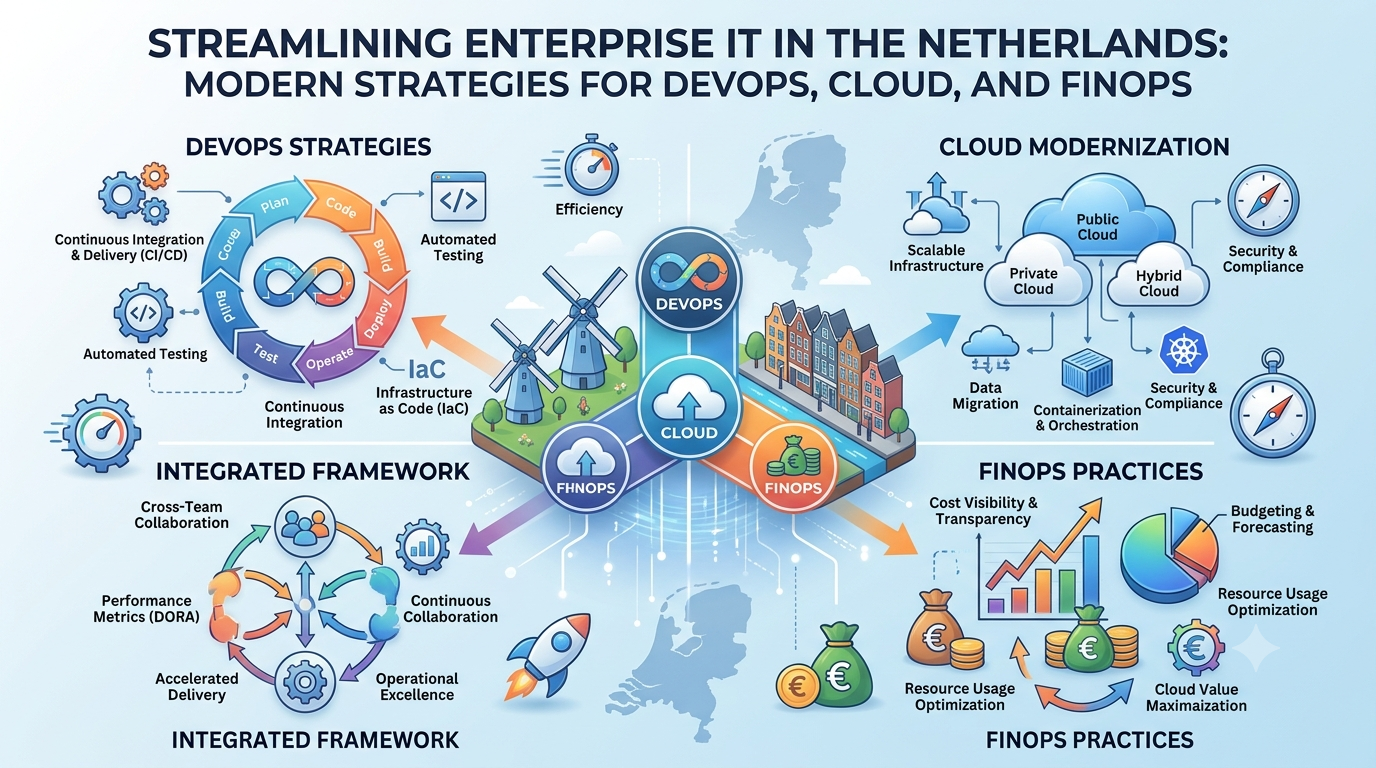
Streamlining Enterprise IT in the Netherlands: Modern Strategies for DevOps, Cloud, and FinOps
 Introduction
High-performing companies rely on rapid code releases and resilient cloud infrastructure to drive growth. Rapidly changing market demands require organizations to continuously refine their software delivery pipelines. By implementing modern automation, engineering teams deliver features faster and maintain operational stability.
Dutch enterprises frequently run into delivery delays due to manual handoffs and fragmented toolchains. Skipping security checks or rushing deployments introduces severe vulnerabilities that risk operational downtime. DevOps Consulting Netherlands guides companies through these technical roadblocks by restructuring workflows and upgrading cloud architecture.
This comprehensive guide outlines actionable training frameworks and specialized consulting services. You will learn how to evaluate cloud platforms, enforce embedded security practices, track infrastructure spending, and upskill technical staff. Read further to create an adaptable technology strategy for your business.
Transforming Business Operations via DevOps Consulting Netherlands
Auditing Development Workflows
DevOps consulting transforms slow development cycles into agile delivery pipelines. Experienced consultants analyze your current software lifecycle to highlight structural bottlenecks. Following this audit, advisors design a tailored strategy to refine team workflows and speed up releases.
Setting Up Continuous Delivery Pipelines
Consultants assist teams in constructing automated delivery pipelines that process code updates seamlessly. Automated testing eliminates manual execution errors, turning weekly release cycles into predictable, low-risk deployments.
Provisioning Infrastructure Through Code
Modern consulting emphasizes infrastructure as code to automate server configurations. Engineers write software scripts to handle environment setup, turning complex provisioning tasks into repeatable actions that save hundreds of engineering hours.
Bridging Engineering and Operations Gaps
Consultants align developers and operations engineers around shared performance goals. Removing operational silos fosters cross-team accountability, eliminates handoff friction, and improves daily software output across the enterprise.
Identifying Internal Priorities First
Review your engineering pain points thoroughly before selecting an external partner. Determine whether your main issue stems from long release cycles, fragile environments, or poor team communication. Clear internal goals guarantee maximum ROI from consulting engagements.
Technical Skill Growth with DevOps Training Netherlands
Expanding Hands-On Engineering Skills
Because technology standards shift rapidly, IT specialists must expand their skill sets continuously. DevOps Training Netherlands equips engineers with practical knowledge in pipeline design, automation scripts, and server administration to streamline everyday operations.
Experiential Labs and Real-World Scenarios
Effective training combines interactive lectures with real-world lab environments. Students complete practical assignments during class modules, testing theories inside safe environments to build confidence with complex tools.
Preparing for Professional Certifications
Targeted training programs prepare candidates for industry-recognized certification exams by reviewing core concepts and practical test scenarios. Earning recognized credentials validates technical competence and accelerates career progression.
Choosing the Ideal Learning Path
Select a training program tailored to your current technical proficiency. Novices need structured introductory modules, whereas senior engineers benefit from advanced exercises focused on multi-cloud orchestration and container management.
Upgrading Enterprise Capabilities with Corporate DevOps Training
Standardizing Organizational Delivery Standards
Corporate DevOps Training establishes uniform tools and operating standards across software teams. Standardizing build scripts and deployment routines removes project confusion, enabling departments to ship software faster and with higher quality.
Evaluating Baseline Team Competencies
Instructors assess your staff's existing technical capabilities to locate skill gaps in automated testing, cloud management, or deployment scripts. Customizing lesson plans around these specific requirements yields maximum value from corporate training budgets.
Interactive Team Problem Solving
During interactive training sessions, teams solve realistic operational challenges together using industry-standard tools. Debugging simulated pipeline errors as a unit builds a highly cohesive, effective engineering team.
Aligning Coursework with Production Tools
Choose a curriculum that directly mirrors your organization's production stack. Practicing concepts on familiar technology environments speeds up skill adoption, allowing developers to apply new knowledge to active projects immediately.
Strengthening Security via DevSecOps Consulting Services
Shifting Security to Early Coding Stages
Software architects must incorporate safety measures during initial design phases. DevSecOps Consulting Services help businesses add automated security checks upfront, preventing critical vulnerabilities and protecting customer data around the clock.
Implementing Automated Safety Scanners
Consultants embed automated security scanners directly inside continuous delivery pipelines. The system inspects code for vulnerabilities during every build, allowing developers to patch security flaws long before applications reach live servers.
Streamlining Compliance Controls
Strict regulatory rules require verifiable data protection standards. Experts implement automated compliance audits that run continuously within pipelines, generating accurate reporting logs for regulators while relieving internal teams of manual auditing stress.
Fixing Vulnerabilities Early
Deferring security reviews to final release phases creates major delays and increases fix costs exponentially. Adopting DevSecOps allows engineering teams to catch and fix vulnerabilities during early development cycles, maintaining scheduled release dates.
Scaling Enterprise Applications via Kubernetes Consulting Services
Orchestrating Containerized Applications
Kubernetes manages containerized software to keep applications running smoothly across complex server environments. The platform automatically restarts failing containers and balances traffic loads, guaranteeing high availability for end users.
Designing Production-Grade Clusters
Kubernetes Consulting Services help organizations design and maintain cluster architectures securely. Consultants establish auto-scaling rules that handle unexpected traffic surges efficiently while scaling down resources during off-peak hours to reduce costs.
Managing Live Application Deployments
Consultants guide internal teams through live cluster deployments while configuring real-time health checks and monitoring metrics. Instant notification triggers allow engineers to fix emerging errors before end users experience service degradation.
Evaluating Infrastructure Requirements
Not every application demands the complexity of a Kubernetes cluster. Simpler web services often operate reliably on basic cloud instances. Consultants provide objective evaluations to prevent companies from adopting unnecessary architectural complexity.
Practical Developer Preparation with Kubernetes Training Netherlands
Mastering Container Basics
Managing containerized software requires structured practice and specialized skills. Kubernetes Training Netherlands introduces software engineers to core container concepts, taking learners step-by-step through Docker commands and cluster management tools.
Package Management with Helm
Course modules cover essential management utilities, including Helm charts and manifest files. Students practice packaging and deploying multi-tier applications in active lab environments, making complex deployment workflows simple to execute.
Preparing for CKA and CKAD Examinations
Focused coursework prepares candidates for official CKA and CKAD certification tests. Students complete timed, practical lab scenarios to build the hands-on troubleshooting abilities necessary to pass rigorous technical exams.
Dedication to Practical Skill Development
Passing technical certification exams requires consistent personal effort outside formal class hours. While training courses supply roadmaps and lab access, ongoing hands-on practice unlocks true technical expertise and career advancement.
Maximizing Uptime via Site Reliability Engineering Consulting
Prioritizing Reliability and Performance
Site Reliability Engineering applies software development principles to IT operations, keeping systems stable, fast, and scalable. Site Reliability Engineering Consulting helps companies build resilient platforms that deliver seamless digital experiences.
Establishing Service-Level Objectives
SRE advisors guide organizations in defining clear service-level objectives (SLOs) and configuring automated monitoring tools. When unexpected outages occur, teams execute pre-defined incident playbooks to restore operations rapidly and minimize downtime.
Uncovering Hidden System Vulnerabilities
Consultants perform health audits to identify bottlenecks across network infrastructure, database connections, and memory allocations. Resolving hidden flaws proactively prevents costly outages during peak traffic periods.
Tracking Operational Quality Indicators
Effective system management requires accurate performance data. SRE consulting introduces concrete metric tracking across operations, enabling leaders to evaluate uptime, latency, and system error rates using intuitive visual dashboards.
Strategic Planning with Cloud Migration Consulting Netherlands
Structuring Cloud Migration Plans
Moving legacy systems to cloud environments demands careful technical planning. Cloud Migration Consulting Netherlands guides organizations through every migration stage, analyzing existing databases, dependencies, and networks to prevent data loss.
Selecting the Right Cloud Platform
Advisors help organizations evaluate major cloud ecosystems, including Amazon Web Services, Microsoft Azure, and Google Cloud. Selecting the cloud platform that best matches your long-term business strategy establishes a scalable foundation for growth.
Securing Data Transits and System Testing
Migrating sensitive files requires robust encryption protocols to safeguard data throughout the migration pipeline. Consultants run complete functional tests prior to final cutovers, ensuring business operations continue without interruption.
Tailoring Strategies to Organizational Needs
Avoid generic migration templates, as every company operates with distinct software architectures and budgetary boundaries. Dedicated consulting provides a custom migration strategy that keeps your cloud transformation on schedule and within budget.
On-Demand Expertise with Freelance DevOps Engineers
Filling Specialized Skill Gaps
Growing enterprises frequently need short-term technical expertise for critical project launches. Organizations can Hire Freelance DevOps Engineers to fill specialized skill gaps rapidly without making long-term hiring commitments.
Assessing Technical Backgrounds
Choose freelancers who possess verified project experience in your specific industry. Reviewing past work across cloud platforms, CI/CD tools, and collaboration channels guarantees seamless integration with your internal workforce.
Establishing Clear Scope and Ownership
Document project deliverables, milestones, security rules, and code ownership rights before signing contract agreements. Setting unambiguous parameters upfront prevents project drift and friction during active work cycles.
Screening Candidate Competencies
Because freelance specialists possess varying skill levels, testing capabilities through initial micro-assignments helps verify technical fit. Matching candidate skills to specific project tasks protects your development schedule.
Cost Optimization through FinOps Consulting Services
Establishing Cloud Expense Transparency
Unmonitored cloud deployments can lead to budget overruns. FinOps Consulting Services provide complete visibility into cloud usage across departments, showing business leaders exactly where capital goes every billing cycle.
Eliminating Idle Infrastructure Waste
Unused cloud resources generate monthly charges continuously. FinOps consultants identify abandoned database instances and oversized virtual machines, helping teams delete waste without compromising application performance.
Aligning Engineering and Financial Goals
FinOps unites technical teams and financial managers around shared fiscal goals. Developers learn how architectural decisions impact monthly cloud bills, while finance managers gain realistic insight into infrastructure demands.
Building Sustainable Cost Habits
FinOps instills long-term financial discipline across development workflows. While cost savings vary based on existing infrastructure setup, continuous resource tracking tools foster smarter technology spending over time.
Comprehensive DevOps Service Matrix
This detailed table compares core DevOps service models to help executives choose the best solution for their immediate operational goals:
Service
Main Purpose
Typical Activities
Suitable For
DevOps Consulting
Accelerate release speed
CI/CD buildouts, workflow audits, pipeline automation
Organizations with slow deployments
DevSecOps Consulting
Enhance system safety
Automated security scans, compliance audits, code checks
Businesses handling sensitive data
Kubernetes Consulting
Manage container platforms
Cluster setups, auto-scaling rules, application deployment
Teams running containerized apps
SRE Consulting
Maximize service uptime
SLO setups, incident playbooks, real-time monitoring
Enterprises requiring 24/7 reliability
Cloud Migration Consulting
Transition to cloud setups
System audits, data transfers, platform testing
Companies modernizing legacy servers
FinOps Consulting
Control cloud spending
Cost audits, idle resource deletion, budget allocations
Businesses managing high cloud bills
Common Mistakes in DevOps Implementations
1. Automating Flawed Processes
Fix manual process bottlenecks before adding automation tools. Automating inefficient routines only speeds up bad outcomes. Standardize your manual steps first, then introduce automation tools to scale good practices.
2. Postponing Security Verification
Leaving security checks for final release phases creates major project delays and forces expensive code rewrites. Integrate security scanning tools into early development steps to keep delivery pipelines moving safely.
3. Purchasing Tools Without Clear Goals
Avoid buying complex software packages simply because they trend in tech media. Pick tools that solve specific operational friction points for your team, as simple solutions yield superior long-term results.
4. Deploying Applications Without Monitoring
Launching software without real-time tracking exposes your business to undetected outages. Implement health tracking tools to receive instant alerts before system issues impact your customers.
5. Migrating Without a Detailed Plan
Moving servers without proper planning causes data loss and service outages. Document software dependencies and compliance requirements upfront to ensure a smooth, secure cloud migration.
6. Running Kubernetes Without Trained Talent
Operating Kubernetes clusters introduces architectural complexity that demands specialized skills. Train your engineering staff or work with external experts before launching production clusters to prevent configuration errors.
7. Overlooking Abandoned Cloud Assets
Leaving unused cloud instances running wastes corporate capital daily. Conduct monthly resource reviews to decommission unused storage volumes and downsize oversized servers.
8. Conducting Training Without Hands-On Labs
Passive lecture formats fail to build operational skill. Quality technical training requires practical exercises inside live lab sandboxes, where hands-on practice builds real workplace confidence.
Evaluation Checklist for Partner Selection
Use this practical checklist to evaluate organizational requirements before contracting an external training or consulting provider:
Area
Questions to Ask
Why It Matters
Current Skills
Which technical competencies does our team lack today?
Defines precise training or consulting requirements
Project Goals
What core business problem must this project solve?
Focuses technical efforts on measurable business outcomes
Tool Choices
Which software tools integrate into our existing stack?
Prevents investments in incompatible software products
Security Needs
Which compliance standards apply to our data assets?
Guarantees system designs satisfy legal requirements
Training Format
Does our team prefer virtual workshops or on-site classes?
Aligns instruction models with team work schedules
Cloud Needs
Which cloud provider supports our application vision?
Guides sensible infrastructure migration planning
Project Budget
What capital allocation have we set for technical implementation?
Prevents budget overruns during consulting engagements
Deliverables
What clear outcomes will our external partner guarantee?
Establishes mutual accountability for target results
Driving Transformation with DevOpsSchool
DevOpsSchool is a Netherlands-based technology training and consulting company. It helps businesses and IT professionals improve their skills in DevOps, cloud computing, automation, and modern software delivery. The organization combines instructor-led classroom learning with enterprise consulting programs.
Its services help organizations update CI/CD pipelines and infrastructure automation. Teams learn to improve software delivery through structured corporate training. DevSecOps services help companies add security testing and compliance controls.
DevOpsSchool also provides Kubernetes, SRE, and cloud migration support. Businesses can connect with freelance specialists for key project roles. FinOps consulting helps organizations manage cloud spending effectively. Together, these services support reliable systems across Europe.
Real-World Case Examples
Case 1: Accelerating Release Timelines
A software company suffered from slow manual release routines that caused frequent website errors. By building automated continuous integration pipelines, the company automated code testing and deployment, converting risky updates into fast, predictable releases.
Case 2: Building Internal Kubernetes Capabilities
An engineering group needed to run microservices on Kubernetes but lacked practical experience in cluster design and Helm management. Participating in interactive workshops with hands-on lab projects allowed the team to manage live production clusters independently.
Case 3: Eliminating Unnecessary Cloud Costs
A growing business faced rising monthly cloud invoices without clear insight into departmental usage. Adopting FinOps methods enabled team managers to locate abandoned cloud instances, shrink oversized capacities, and reduce monthly spending while preserving app performance.
Frequently Asked Questions
Which technical challenges does DevOps Consulting Netherlands solve?
DevOps Consulting Netherlands helps organizations modernize software delivery workflows. Technical advisors evaluate operational processes, build continuous integration pipelines, and automate infrastructure management routines. These interventions enable engineering teams to release software updates faster while reducing system errors. Furthermore, consultants foster collaboration between development and operations teams, improving overall software delivery efficiency across the enterprise.
How does DevOps Training Netherlands assist career growth?
DevOps Training Netherlands provides hands-on skill development for technology professionals. Participants learn to use modern automation tools, manage cloud environments, and build continuous delivery pipelines. Quality programs combine live instructor guidance with practical lab exercises and exam preparation, empowering engineers to manage enterprise infrastructure efficiently across daily operations.
Why do organizations choose Corporate DevOps Training?
Corporate DevOps Training delivers customized instruction tailored to specific enterprise goals. The program helps organizations standardize development tools, deployment automation scripts, and testing practices across teams. Establishing shared workflows removes operational confusion, improves software quality, and ensures smoother collaboration across internal project divisions.
How do DevSecOps Consulting Services protect applications?
DevSecOps Consulting Services embed security controls directly into active software pipelines. Technical experts integrate automated vulnerability scanners, compliance audits, and secure coding practices upfront. Identifying security defects early prevents expensive launch delays, helping businesses safeguard sensitive customer data while maintaining rapid software deployment schedules.
When should an enterprise hire Kubernetes Consulting Services?
An organization should request Kubernetes Consulting Services when managing containerized application workloads at scale. Advisors assist teams with cluster architecture design, auto-scaling rules, application deployments, and live health monitoring. Expert guidance prevents configuration errors, maximizes uptime, and optimizes resource consumption without overburdening internal IT teams.
Can developers prepare for certifications via Kubernetes Training Netherlands?
Kubernetes Training Netherlands teaches core container orchestration concepts to software engineers. The curriculum covers Docker containerization, cluster architecture setups, Helm package configurations, and routine administration. Students complete practical tasks inside live lab sandboxes to prepare for CKA or CKAD certification exams, gaining real-world cluster management skills.
What goals does Site Reliability Engineering Consulting focus on?
Site Reliability Engineering Consulting focuses on maintaining service stability, speed, and overall system uptime. Consultants implement real-time monitoring tools, establish service-level objectives, and construct clear incident response playbooks. Resolving structural bottlenecks minimizes operational downtime, helping businesses deliver consistently reliable digital experiences to end users.
How do consultants execute Cloud Migration Consulting Netherlands projects?
Consultants execute Cloud Migration Consulting Netherlands by guiding businesses through structured cloud transitions. Advisors evaluate legacy architectures, select suitable cloud platforms such as AWS or Azure, and execute secure data transfers. Comprehensive testing runs prior to final cutovers to guarantee applications perform reliably without interrupting business operations.
What parameters should guide hiring Freelance DevOps Engineers?
A business can Hire Freelance DevOps Engineers to secure specialized technical talent for short-term project needs. Organizations must define clear project scopes, required technical competencies, and security parameters upfront. Screening candidate portfolios across relevant pipeline and cloud tools ensures you contract qualified specialists who fit your project timeline.
How do FinOps Consulting Services decrease monthly cloud spend?
FinOps Consulting Services enable organizations to track, manage, and optimize cloud infrastructure costs. Advisors establish usage tracking dashboards, define departmental budgets, and identify unallocated resources. Aligning financial leaders with engineering teams eliminates cloud waste, clarifies cost allocation, and promotes informed decision-making regarding long-term infrastructure investments.
Does completing DevOps training guarantee industry certification?
Professional DevOps training equips IT specialists with essential skills in system automation, cloud operations, and continuous integration. Mastering modern engineering tools enhances daily job performance and opens new professional pathways. Earning industry-recognized certifications proves technical competence to employers, helping engineers stay competitive in an evolving technology landscape.
What services does DevOpsSchool provide across European markets?
DevOpsSchool delivers integrated technology training and technical consulting across the Netherlands and Europe. The company provides professional courses, corporate team training, and advisory services covering Kubernetes, DevSecOps, SRE, and cloud migrations. Companies can also source freelance specialists or apply FinOps consulting to control cloud spending effectively.
Strategic Summary and Next Steps
Adopting modern DevOps methodologies and expert training allows companies to automate deployment pipelines, embed security protocols, increase application reliability, and optimize cloud expenses. Sustainable digital transformation requires clear internal goals and reliable consulting partnerships. Audit your internal tech stack to pinpoint your primary operational bottlenecks before investing in new tools. Partnering with DevOpsSchool gives your team access to high-impact training courses and enterprise consulting solutions tailored to your growth strategy. Schedule an internal skill assessment today to map out a clear path toward digital maturity.